The modern hotel tech stack has evolved — have you evolved with it? Hotels used to rely on disconnected programs to run every stage of the guest journey (most have used 15 to 20 software systems), but now it’s all about integration and connection. Hotels today require technology that shares data, automates repetitive tasks and lets staff deliver faster, more personalized service. And as AI becomes an operational necessity, it’s more important than ever to stay in step.
This guide covers how hotel technology has evolved over the past five years, the categories every property should know and how to build and fine-tune a stack where the systems actually work together.
Key highlights:
A hotel technology stack is the connected collection of software a property uses to manage reservations, payments, operations and the guest experience.
Hotel tech stacks have shifted from disconnected single-task tools to cloud platforms that share data through Application Programming Interfaces.
The strongest stacks prioritize business and guest goals with robust integration across systems.
Canary's connected platform modernizes hotels’ guest-facing technology without adding more disconnected point solutions.
What Is a Hotel Technology Stack?
A hotel technology stack is the collection of software your property uses to operate, including hotel management software, like a property management system (PMS), booking engines, payment tools, messaging platforms, housekeeping apps and revenue systems. These platforms within your “stack” depend on one another. In other words, your guest messaging tool is only as smart as the reservation data feeding it.
When the layers connect, a guest makes a booking, gets a check-in link automatically, pays from their phone and walks past the front desk line to their room. When they aren’t connected, your agent retypes the same guest's name into three screens at 11 p.m.
How Has the Hotel Tech Stack Evolved Over the Past Five Years?
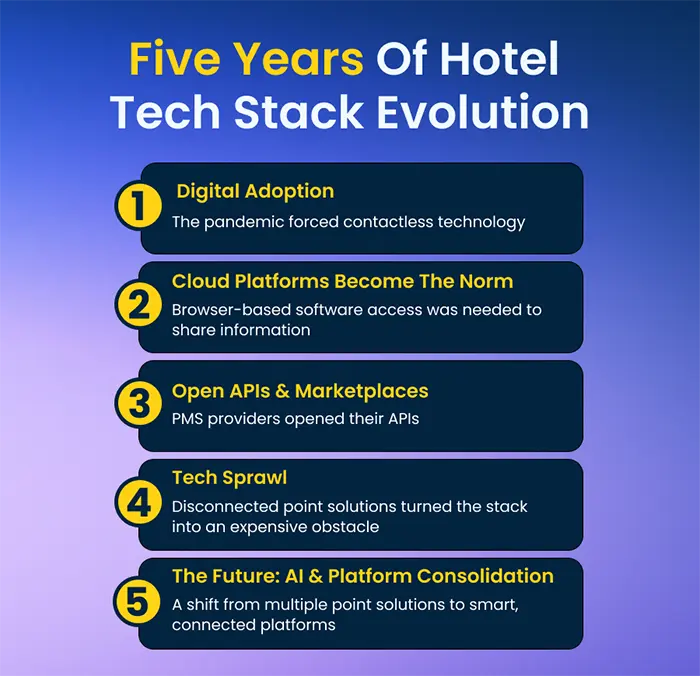
The hotel tech stack has evolved faster in the past five years than in the previous 20, moving from fragmented, on-premise tools to cloud-based, connected and increasingly AI-powered ecosystems. Three forces drove the shift: a pandemic that made contactless service non-negotiable, the decline of server-room software and the arrival of practical AI.
Contactless Technology Accelerated Digital Adoption
2020 forced the issue. Hotels that had treated digital check-in as a someday project suddenly needed it immediately. According to Hotel Tech Report, 81.7% of hoteliers implemented or planned at least one new technology during the pandemic, most of it contactless.
Guests never went back. An Oracle study found that 73% of travelers want to handle booking, check-in and room service from their smartphones. Contactless check-in went from novelty to expectation, and it changed daily operations:
The lobby got quieter: The front desk stopped being a frustrating bottleneck and became a choice.
Guest data arrived earlier: Capturing emails and phone numbers before arrival opened the door to pre-stay upsells.
Paper started disappearing: Registration cards and printed folios were replaced with secure digital check-ins.
Cloud-Based Platforms Replaced Legacy Systems
The old on-premise PMS needed its own server, annual updates and a technician on call, often locking information away. Cloud-based hospitality technology solutions are built to share information. Now, a 40-room independent can use the same caliber of tools as a 400-room resort.
The practical wins:
No hardware to maintain: There’s nothing to patch, replace or worry about during a power outage.
Automatic updates: New features arrive continuously instead of once a year.
Access from anywhere: Managers can check occupancy from a laptop or phone, on or off property.
APIs Expanded the Hotel Technology Marketplace
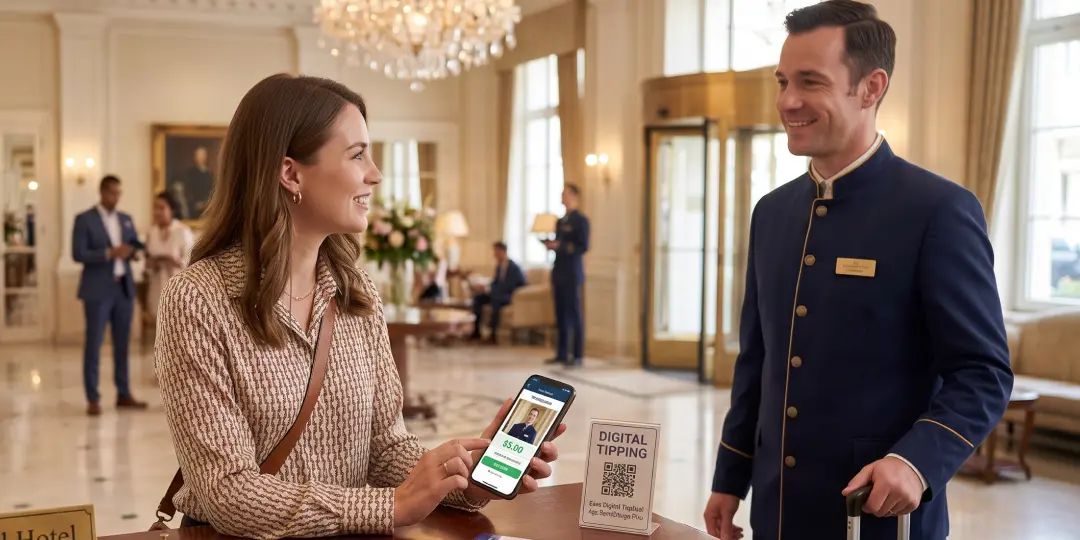
APIs reshaped the hotel software market, letting systems share data with each other. But once PMS providers opened their APIs, thousands of specialized tools — upsell platforms, digital tipping, smart locks and review management — could plug in. For hoteliers, this was mostly good news. They were no longer stuck with whatever their PMS vendor bundled in. They could pick the best tool for each job and connect everything through hotel tech integrations.
The catch: "it integrates" can mean almost anything. Some integrations synced in real time. Others pushed one file overnight. The difference decided whether restaurant charges reached the folio before the guest checked out.
Technology Sprawl Created New Challenges
All that choice created a new problem. Hotels added tools one at a time, each solving a real problem — one app for messaging, another for housekeeping, a third for tips, a fourth for upsells — until the stack became the problem.
Hotel Tech Report found that 63% of a typical hotel's technology budget goes to maintaining existing systems, leaving little for anything new. This is why many operators now consolidate and streamline hospitality operations rather than add another tool. Sprawl costs show up in three places:
Duplicate features: Tools doing identical jobs on separate invoices.
Scattered guest profiles: The PMS knows one thing, the messaging app knows another and neither syncs.
Slow training: New hires face a wall of logins before they ever greet a guest.
AI and Connected Platforms Began Consolidating the Stack
Now, hoteliers are consolidating their stacks, with AI doing much of the work. Instead of 10-point solutions from 10 vendors, hotels are moving to connected platforms where messaging, check-in, payments and upsells share one system and one guest profile.
AI made consolidation genuinely useful. Hospitality AI agents now answer routine guest questions around the clock, in the guest's own language and pull staff in only when a conversation needs a human. Five years ago, hotel AI meant a clunky chatbot. Today, it answers phones, drives upsell revenue and covers the night shift's busywork.
What Hotel Tech Solutions Are Included in Modern Tech Stacks?
Modern stacks group hotel tech products into five core categories, and nearly every tool you'll evaluate fits one of them. Some properties need all five. A 30-room inn might need three. Use the map below to audit what you have and spot what's missing from your modern hotel tech stack.
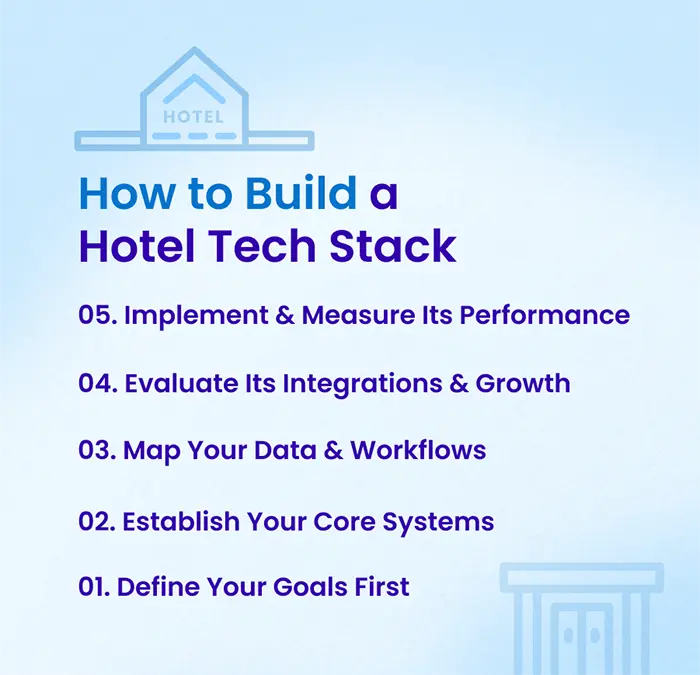
You build a hotel tech stack by prioritizing your goals, your guests, and your existing systems, not a vendor's feature list. Hotels that skip this step end up with far too many software licenses across their portfolios, which can cost time and money. Here’s how to intentionally build yours step by step.
Define Your Business and Guest Experience Goals
Before you evaluate a single product, write down what you're trying to change. Faster check-in? More upsell revenue? Fewer 2 a.m. calls to the front desk? Different goals point to different tools.
Map how a guest moves through your property today, from booking to checkout, and circle the friction points. A guest experience platform can smooth most of that path, but only if you know which moments are broken. Start with three questions:
Read your reviews: What do guests complain about most often?
Shadow a shift: Where does your staff lose the most time?
Follow the money: Which revenue opportunities are you missing?
Establish Core Systems
Your PMS comes first. It holds your reservations, rates and guest data, so every other decision is affected by it. If you're switching your PMS, switch it before anything else. Tools chosen to fit an old PMS may not fit the new one.
Once your core systems are settled, add the essentials in order of operational pain: payments, a booking engine, a channel manager.
Map Data and Workflow Requirements
Trace how your information needs to move. When a guest books, what should happen automatically? When housekeeping flags a broken AC unit, who finds out and how fast?
Sketch these flows before you buy anything. Every point where data jumps between systems is either an integration or a person retyping information. The retyping is where errors start.
Evaluate Integrations and Scalability
When comparing vendors, find out how their integrations actually behave:
Check the speed: Is the sync real-time or batched overnight?
Check the price: Is the integration pre-built and supported, or a custom project with its own invoice?
Check the failure mode: What happens to your workflows when the connection breaks?
Then think two or three years out. Will this tool still fit when you add a second property or 50 more rooms? The best hotel tech stack grows with you.
Implement and Measure Performance
Roll out your new stack in phases, train thoroughly and pick your success metrics before launch (check-in time, upsell revenue per stay, front desk call volume, review scores). Review the numbers at 30, 60 and 90 days from launch. Tools that aren't earning their keep get fixed, replaced or cut.
Hotel Tech Stack Optimization
Hotel tech stack optimization means regularly pruning, tuning and upgrading what you already own, and it's where established properties find the fastest wins. You probably don't need more software. You need the software you have to work harder.
Run this audit once a year, twice if you're growing fast:
Business Value: Match every subscription to a measurable outcome. If a tool can't point to revenue gained, hours saved or scores improved, it's a candidate for the chopping block.
System Overlap: Hunt for tools doing the same job, like two messaging platforms or a PMS with built-in upsells running alongside a separate upsell app. Almost every stack has some overlap.
Integration Quality: Check how well your systems share data today. Connections degrade as vendors update their software. A sync that worked at launch may now be dropping records.
Employee Adoption: Watch your front desk for an hour and note which tools they use and which they work around. The software your team avoids is a monthly fee, not an asset.
Scalability and Readiness: Ask whether each system can handle where you're headed, whether that's more rooms, more properties or the AI capabilities guests expect.
Maintain a Scalable Hotel Tech Stack With Canary
The goal is to run a better hotel with less friction — for your guests and your team.
Canary’s Guest Management Platform brings the guest-facing side of your modern hotel tech stack into a single connected system that plugs into the PMS you already run: one vendor, one login and one guest profile instead of five more point solutions. Core capabilities for both independents and global brands include:
Mobile check-in with ID verification and secure payment
AI-powered guest messaging and voice across every channel
Dynamic upsells that reach guests at the right moment
Digital tipping and smart checkout
Real-time updates that keep the front desk and housekeeping in sync
Most independent hotels spend between $850 and $2,000 per month on software, though the range varies with property size. Per-room pricing is common: cloud PMS platforms often start at $10 to $15 per room per month, with guest experience and revenue tools layered on top. The bigger cost question is usually waste, since 63% of the average hotel's tech budget goes to maintaining what's already there.
What is the difference between a hotel PMS and a CRS?
A PMS (property management system) runs your property day-to-day: check-ins, room assignments, housekeeping status, guest folios. A CRS (central reservation system) manages reservations and availability across multiple properties or distribution channels and pushes bookings down to each PMS. Independent hotels often need only a PMS. Groups and brands typically need both.
What is a fragmented hotel tech stack, and how do you avoid one?
A fragmented hotel stack is a collection of tools that don't share data, forcing staff to retype information and leaving guest profiles scattered across systems. Avoid it by buying with integration in mind: choose platforms over point solutions where possible, verify how each integration behaves before signing and audit for overlap every year.
How do you audit your existing hotel technology stack?
List every subscription, what it does and what it costs, including per-room fees and payment markups. Map which systems talk to each other, estimate the hours staff spends bridging gaps manually and flag tools with overlapping features. Score each against business value and staff adoption. Whatever lands at the bottom is your shortlist for renegotiation or removal.